Claude Web Search Has a Spam Problem. I Tested It Against Google.
I ran 10 everyday searches through Google, Brave, Exa, Parallel and Claude’s built-in web search. Claude’s default mode returned spam in 13 of its top 100 results; the others returned none. Here is why it happens, what Anthropic has said, and the search stack I now use for research.
Claude’s built-in web search is quietly returning a lot of junk. On October 30, 2026 I ran the same 10 everyday searches through Claude, Google, Brave, Exa and Parallel. Claude’s default search put 13 spam pages in its first 100 results, most of them on hijacked-looking university and corporate subdomains, and matched only 6% of Google’s top results. Brave, Exa and Parallel returned zero spam.
The cause is not Google’s new habit of feeding fake results to scrapers. It looks like a new search index that Claude switched to in October without an announcement. Below is the test, what it means for anyone who researches with Claude, the search setup I now use instead, and what I expect to change.
How this started: a Google earnings call
A teammate mentioned in a meeting that Google was finally losing money to its own AI answers. That was close but not quite right. Google Search revenue still grew 12% in Q3 2026, to $63.3 billion, but growth slowed, and Google’s chief business officer said the surge in AI Mode queries hurt because AI Mode monetizes at a lower rate [1]Search Engine Land · Oct 2026Google: AI Mode's lower monetization slowed Search ad growthSearch revenue grew 12% to $63.3B, and Google said AI Mode queries monetize at a lower rate.View source ↗. Google’s answer is more ads inside AI Overviews and AI Mode.
That stuck with me because I barely use Google anymore. When I want to know something, I ask Claude. So the next piece of news hit differently: Google has started feeding fake search results to the bots that scrape it. If the AI tools I rely on get their facts from scraped search results, are they being fed junk too?
Google is feeding fake results to scrapers
Since late September 2026, Google has been answering some automated searches with complete, normal-looking results pages where most of the real results are swapped out. Rank tracker Nozzle analyzed 27.5 million results pages and found 8.0% poisoned since September 13, against 0.17% before [2]Nozzle · Oct 2026Poisoned Google SERPs27.5M SERPs analyzed: 8.0% poisoned since Sep 13, 2026, versus 0.17% before.View source ↗. Ahrefs put the affected share at 5% to 20%, depending on the data provider [3]Ahrefs · Oct 22, 2026An update on Google's poisoning of search resultsAhrefs puts affected results at 5% to 20%, depending on the data provider.View source ↗, and DataForSEO estimated 20% to 30% of its scraped results since September 26 [4]DataForSEO · Oct 2026Poisoned SERPs: what's happening with Google resultsDataForSEO's CTO estimates 20% to 30% of scraped results were poisoned since Sep 26.View source ↗.
Most people watching this think AI companies are the real target and SEO tools are collateral damage. Google sued the scraping service SerpApi in December 2025 [5]Google · Dec 19, 2025Why we're taking legal action against SerpApi's unlawful scrapingGoogle sued SerpApi for circumventing the protections on its search results.View source ↗, and SerpApi has been reported to count OpenAI and Perplexity among its customers [6]Search Engine Land · Aug 2025ChatGPT's answers came from Google Search after allReporting that OpenAI used SerpApi to pull Google results, with Perplexity also listed as a customer.View source ↗. One SERP API vendor measured SerpApi’s pages coming back degraded on about a third of reads [7]cloro · Oct 2026Poisoned Google SERPs: what we measuredPages pulled through SerpApi came back degraded on about a third of reads.View source ↗.
The squeeze started a year earlier, when Google dropped the setting that let tools pull 100 results per page in one request [8]PPC Land · Oct 2026Ahrefs says Google poisons 5% to 20% of results served to SEO data toolsIncludes a timeline back to Google dropping the num=100 parameter on Sep 14, 2025.View source ↗.
What nobody has published yet is a study of how much of this poison ends up inside AI answers. So I ran a small test of my own.
The test: 10 searches, 5 search sources
I picked 10 generic queries far away from my own niche, so nothing I work on would skew the results: how to fix a leaky faucet, best running shoes, what causes the northern lights, sourdough starter recipe, noise cancelling headphones, how long to boil eggs, used car prices, how to train a puppy, cast iron skillet care, and best budget laptop.
- Google and Brave: run from my own logged-in Chrome on my home connection, read straight from the results page.
- Claude’s built-in web search: in its default mode, the one Claude uses unless something pushes it to search more broadly.
- Exa and Parallel: two independent search indexes built for AI agents, connected to Claude as MCP connectors.
Claude ran every search itself, including driving my Chrome for the Google and Brave checks.
For each source I measured two things. First, root-domain overlap with Google’s top organic results. Second, junk in the first 10 results: pages on hijacked or abandoned subdomains hosting off-topic SEO filler, plus obvious content farms.
Caveats up front: this is one night and 10 queries, and my Google results are personalized to my account, location and desktop. Overlap with Google is also not a quality score. Plenty of good pages never rank on Google’s first page.
The results
| Query | Claude default: junk in first 10 | Claude default: Google overlap | Brave: Google overlap |
|---|---|---|---|
| how to fix a leaky faucet | 4 | 1 of 6 | 5 of 6 |
| best running shoes | 1 | 1 of 7 | 4 of 7 |
| what causes the northern lights | 0 | 0 of 6 | 5 of 6 |
| sourdough starter recipe | 0 | 0 of 6 | 5 of 6 |
| noise cancelling headphones | 0 | 1 of 7 | 5 of 7 |
| how long to boil eggs | 8 | 0 of 5 | 5 of 5 |
| used car prices | 0 | 1 of 7 | 3 of 7 |
| how to train a puppy | 0 | 0 of 7 | 4 of 7 |
| cast iron skillet care | 0 | 0 of 7 | 5 of 7 |
| best budget laptop | 0 | 0 of 7 | 4 of 7 |
The worst case was the most harmless query. For how long to boil eggs, 8 of Claude’s first 10 results were recipe filler parked on subdomains of universities, a software company and other unrelated sites. That pattern matches the parasite SEO campaigns that have hit universities this year, from hacked Stanford subdomains [9]Stanford Daily · May 2026Stanford subdomains targeted by black-hat SEO attacksHacked university subdomains ranked in search and were even summarized by an AI answer.View source ↗ to 34 hijacked subdomains at schools including MIT and Harvard [10]EdScoop · 2026Threat actor hijacked subdomains at 30+ major universities34 .edu subdomains, including MIT, Harvard and Stanford, were taken over to host spam.View source ↗.
| # | Claude, default search | Google, my browser |
|---|---|---|
| 1 | php5.cdeworld.com | AI Overview, then reddit.com |
| 2 | siegfriedt-survey.umb.edu | incredibleegg.org |
| 3 | jcs.cottagelabs.com | simplyrecipes.com |
| 4 | myshare-cms.siemens.com | facebook.com |
| 5 | api2.apination.com | 101cookbooks.com |
| 6 | elearning.midasuser.com | (Brave: the same five, plus RecipeTin Eats) |
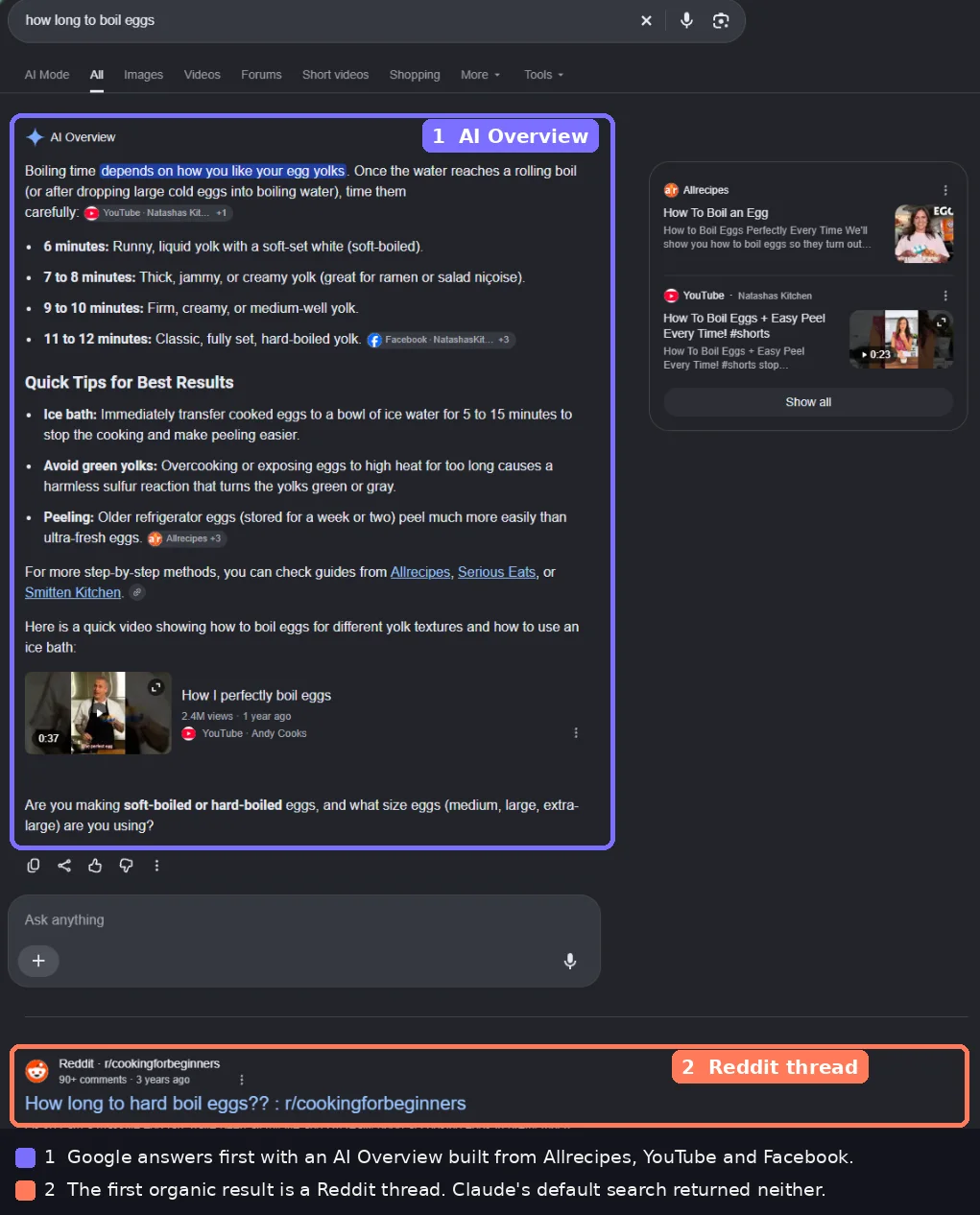
The junk was not the only problem. Claude’s default results also leaned on stale roundups from 2021 to 2024, served UK, Australian and Canadian pages to a US searcher, and answered used car prices with years-old news stories while Google and Brave returned live pricing tools. And none of Claude’s results came from Reddit, which showed up in 8 of Google’s 10 result sets.
Why Claude’s results looked so different
First, this is not Google’s poisoning. Claude’s search does not come from Google. Anthropic’s published subprocessor list names Brave Search as a web search provider [11]Anthropic Trust CenterSubprocessorsAnthropic's published list of vendors that process Claude data, including web search providers.View source ↗, and one analysis found 79.2% of about 35,000 Claude citations sitting in Brave’s top 10 [12]MERJ · Jul 2026How Brave Search discovers new pagesCites Profound data: 79.2% of ~35,000 Claude citations sat in Brave's top 10, versus 34% for Google's.View source ↗.
But that is where my test got interesting. Brave’s own results, run from my browser, overlapped Google 69% with zero junk. Claude’s default results looked nothing like Brave’s. So whatever Claude’s default search is running on now, it is not plain Brave.
Writesonic noticed the same thing from the other direction. Around October 5, 2026, Claude’s search tool started carrying a mode setting, standard or extended. Standard mode, the default, overlapped Brave’s API results only 13.3% and Parallel’s 11.3% [13]Writesonic · Oct 2026Claude Changed Its Search Index, And Told No OneSince about Oct 5, Claude search has standard and extended modes; standard overlaps Brave only 13.3%.View source ↗. Anthropic’s subprocessor list now names three web search providers: Brave, TurboPuffer, which is a search database rather than a crawler, and Parallel, added October 15 [14]TofuBofu · Oct 29, 2026What Search Engine Does Claude Use? Anthropic Names ThreeBrave, TurboPuffer and Parallel are listed for web search; Parallel was added Oct 15, 2026.View source ↗.
So I re-ran my two worst queries in extended mode. How long to boil eggs came back clean: RecipeTin Eats, 101 Cookbooks, Food Network, Healthline. How to fix a leaky faucet improved but still let 3 junk results into the first 10, all of them on university subdomains.
My read, and it is an inference: standard mode is running on a newer, smaller index, possibly Anthropic’s own, that has not yet learned to filter parasite spam the way Google and Brave do. Extended mode reaches a broader pool and is much cleaner, but not spotless.
What Anthropic has said
Nothing about the October change, as far as I can find. Writesonic found no mention of it in Anthropic’s release notes.
Anthropic has dealt with this problem before, though. In its write-up on how it built Claude’s Research feature, the team said its early research agents kept choosing SEO content farms over authoritative sources like academic PDFs, and that adding source-quality rules to the prompts fixed it [15]Anthropic Engineering · Jun 2025How we built our multi-agent research systemEarly research agents preferred SEO content farms; source-quality heuristics in the prompts fixed it.View source ↗. Separately, the API’s search tools gained code-based filtering in February 2026, which Anthropic says raised accuracy 11% while using 24% fewer input tokens on its benchmarks [16]Claude · Feb 2026Improved web search with dynamic filteringAPI search tools now filter results with code; +11% accuracy and 24% fewer input tokens on benchmarks.View source ↗. That filtering targets relevance, not spam.
If you hit junk sources in Claude, the thumbs-down button is the feedback channel. A concrete side-by-side like this one is the kind of report that helps.
The fix: a search stack, not a search engine
I did not want to stop using Claude for research. I wanted to control what it reads. So I added two search connectors and wrote a standing rule into Claude’s memory, in my main profile and in every project, that tells it which source to use for what.
- Exa first for any real research.
- Claude’s own search in extended mode as the second source.
- Parallel as the tie-breaker when the first two disagree.
- Brave, through my own Chrome, for Reddit, forums and community sources, with Google only for spot checks. If a CAPTCHA appears, Claude stops and I click through it myself. It will not solve one for me.
- Claude’s default search only for quick lookups, where one low-stakes fact is the whole job.
Every source then passes the same gate: hijacked subdomains, content farms and undated filler get dropped, primary sources beat aggregators, and fringe or unpopular sources stay in but get labeled as such. When results come back thin or contradictory, Claude has to say so and name which sources it used, instead of smoothing over the gap.
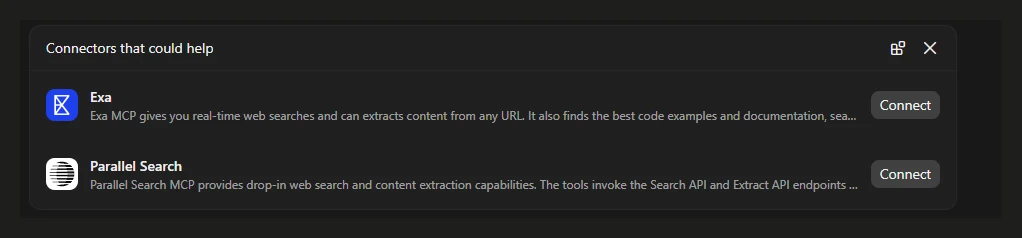
Both connectors are free at my volume, with no card on file. Parallel’s search works anonymously, with no account or API key, and keyless calls are not billed [17]Parallel DocsParallel MCP ServerSearch and fetch are free without an API key; keyless calls are not billed.View source ↗. Exa’s free tier gives $10 in credits a month with no payment method, and requests simply stop when the credits run out [18]Exa DocsBilling and Rate LimitsFree tier: $10 in credits monthly, no payment method; requests stop when credits run out.View source ↗. Neither runs in your browser; they only see the queries Claude sends them.
Does this burn more tokens?
A little, if you are careless. Each search, from any of these sources, drops several thousand tokens of results into the conversation. Swapping one source for another is roughly a wash. Running every source on every question is what doubles or triples the bill, so the rule is one source per query unless a claim matters or the results disagree.
Two habits do more than anything else. Ask for fewer results on quick lookups, and start a fresh chat for each big research task, because every result in a long chat gets re-read on each new turn.
I audited my own research
The uncomfortable question: how much junk was already in work I had built with Claude? I spot-checked a long research document with 665 source links across 326 domains.
It held up well, mostly because it leaned on primary documents: declassified government files, agency records and peer-reviewed papers. A random sample of 12 links was clean. Of the 10 weakest-looking sources, three needed fixes:
- A true claim cited to an anonymous explainer site. The primary source existed and confirmed it, so the citation gets swapped for it.
- A quote cited only to a ghost-story blog. I could not find the original interview, so it needs the primary clip or it gets cut.
- A real study linked through a random file attachment instead of the journal.
The lesson: depth protected the work. Junk does the most damage on quick, generic searches, where nobody clicks through to check.
What this means for SEO and GEO
- Ranking on Brave is no longer the whole Claude story. With three search providers behind Claude, check that Claude-SearchBot and Parallel’s ShapBot are allowed in your robots.txt.
- Reddit-first playbooks do not port to Claude. One study of 379,321 Claude citations from June 2026 found Reddit cited zero times [19]Otterly.AI · Jun 2026Claude AI Citations StudyAcross 379,321 Claude citations in June 2026, Reddit was cited zero times.View source ↗.
- Audit your own subdomains. Abandoned DNS records are how spammers borrow your domain’s trust, and that spam now reaches AI answers.
- Sanity-check rank tracker drops since late September against Search Console before you change strategy. Some of those cliffs are poisoned data.
What will likely change
These are predictions, not reporting:
- Claude’s default search will get cleaner. New indexes improve fast once spam patterns are known, and this one is weeks old. I expect either better filtering or more traffic routed to the broader mode.
- Google keeps walling off its results. Poisoning is cheaper for Google than lawsuits, and SEO tools will keep building filters around it.
- AI search splits by index. Claude, ChatGPT, Perplexity and Gemini increasingly read different slices of the web, so GEO becomes a multi-index job.
Frequently asked questions
What search engine does Claude use?
Anthropic does not publish its routing, but its subprocessor list names three web search providers: Brave Search, TurboPuffer and Parallel. Independent tests found Claude’s default mode no longer closely matches Brave’s results.
Does Claude use Google search?
Not as far as anyone has shown. Google is not on Anthropic’s list of web search providers, which is also why Google’s poisoning of scrapers does not directly reach Claude.
Is Claude’s web search reliable?
For quick facts, usually. For research, check the sources it cites. In my test the default mode returned spam on 3 of 10 queries, while the broader extended mode was much cleaner.
What is the difference between standard and extended mode?
Both are settings on Claude’s search tool. Standard is the default and searches a narrower set of sites. Extended searches more broadly and, in my retest, returned far less junk.
Do Exa and Parallel cost money?
Not at personal-research volume. Parallel works with no account or key. Exa’s free tier includes monthly credits with no card required, and it stops instead of billing when they run out.
Sources
- Google: AI Mode's lower monetization slowed Search ad growth, Search Engine Land · Oct 2026
- Poisoned Google SERPs, Nozzle · Oct 2026
- An update on Google's poisoning of search results, Ahrefs · Oct 22, 2026
- Poisoned SERPs: what's happening with Google results, DataForSEO · Oct 2026
- Why we're taking legal action against SerpApi's unlawful scraping, Google · Dec 19, 2025
- ChatGPT's answers came from Google Search after all, Search Engine Land · Aug 2025
- Poisoned Google SERPs: what we measured, cloro · Oct 2026
- Ahrefs says Google poisons 5% to 20% of results served to SEO data tools, PPC Land · Oct 2026
- Stanford subdomains targeted by black-hat SEO attacks, Stanford Daily · May 2026
- Threat actor hijacked subdomains at 30+ major universities, EdScoop · 2026
- Subprocessors, Anthropic Trust Center
- How Brave Search discovers new pages, MERJ · Jul 2026
- Claude Changed Its Search Index, And Told No One, Writesonic · Oct 2026
- What Search Engine Does Claude Use? Anthropic Names Three, TofuBofu · Oct 29, 2026
- How we built our multi-agent research system, Anthropic Engineering · Jun 2025
- Improved web search with dynamic filtering, Claude · Feb 2026
- Parallel MCP Server, Parallel Docs
- Billing and Rate Limits, Exa Docs
- Claude AI Citations Study, Otterly.AI · Jun 2026
Want the playbook, not just the theory?
The AEO & GEO Playbook is the full done-with-you system for getting cited by AI: every lever that moves AI citations, the templates, and the exact steps I run. The free Field Notes are the taster; the playbook is the whole thing.