Generative Engine Optimization (GEO): How to Get Cited by AI in 2026
Generative engine optimization is how you get surfaced and cited inside AI answers, from Google AI Overviews to ChatGPT and Perplexity. Here is what GEO actually is, how it differs from AEO and SEO, and the levers that move AI citations, with the data behind them, plus the tactics that do nothing.
Generative engine optimization, or GEO, is the practice of getting your content surfaced and cited inside AI-generated answers: Google AI Overviews, ChatGPT, Perplexity, Gemini, and the rest. It is the discipline that sits over answer engine optimization and classic SEO, and in 2026 it is increasingly where your buyers see you, or do not.
This guide covers what GEO actually is, how it differs from AEO and SEO, and, most usefully, the levers that move AI citations, with the data behind them, plus the popular tactics that do nothing.
What generative engine optimization is
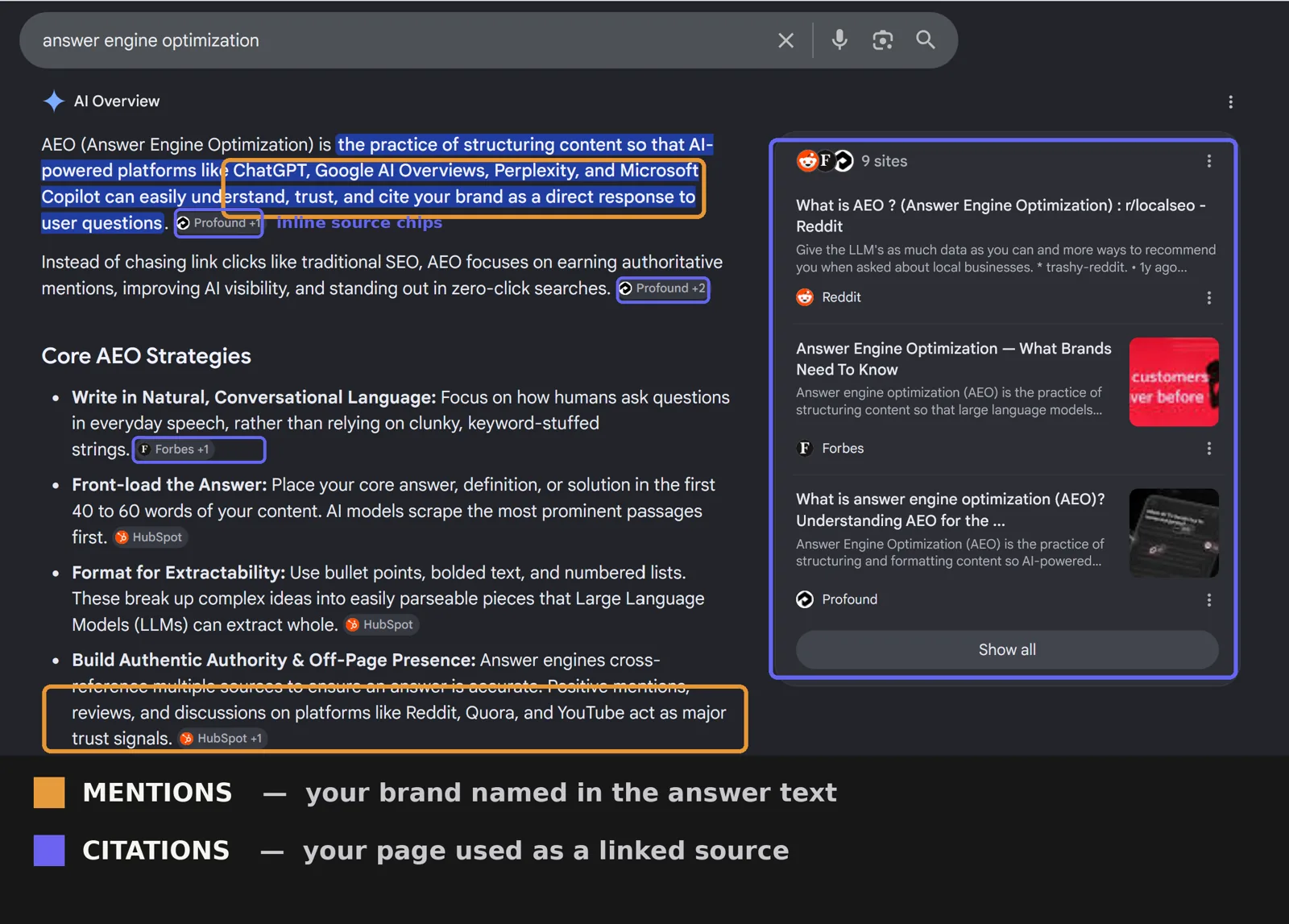
Generative engine optimization is optimizing your content, your brand, and your off-site presence so generative AI systems cite and recommend you when they answer a question. Where classic SEO tries to rank a page in a list of links, GEO tries to make your page the source the AI builds its answer from. The unit of victory is not a position, it is a citation.
That reframes the job. An AI answer names a few sources and moves on, so being the fourth-best page is often being invisible. And because most AI citations come from pages that do not rank in the traditional top 10, [2]Ahrefs · Mar 202638% of AI Overview Citations Pull From The Top 10Most AI Overview citations come from pages outside the top 10 organic results. Ranking and being cited are different games.View source ↗ you cannot assume good rankings hand you AI visibility for free.
GEO vs AEO vs SEO
Short version: SEO gets you ranked, AEO gets you cited, and GEO is the umbrella over both. They share a goal and most of their tactics. The difference is the surface.
- SEO (search engine optimization): earn a position in the classic ten blue links. The reader clicks through to you.
- AEO (answer engine optimization): earn a citation inside an answer engine’s response. The page-level craft of being the quoted source.
- GEO (generative engine optimization): the broad discipline of being visible across generative AI search, on-page and off. It treats AEO as one lever and adds brand mentions, multi-engine presence, and crawlability.
In practice we run them as one motion with three lenses. The AEO work is how a single page gets quoted; GEO is the wider system, mentions, freshness, and presence across engines, that makes the quoting likely in the first place. If you want the page-level tactics, that is the answer engine optimization playbook. This piece is the system around it.
Why GEO matters now
GEO matters now because the answer increasingly replaces the click. AI Overviews sit above the results on more queries every month, and the informational search that used to send you traffic now often ends inside the answer. If you are not the source that answer is built from, you are not in the consideration set at all.
It also rewrites who wins. Being cited correlates far more with how widely your brand is mentioned across the web than with your backlink count, [1]Ahrefs · 2026AI Overview Brand Visibility FactorsBranded web mentions correlate with AI Overview visibility far more strongly than backlinks (about 0.66 vs 0.22).View source ↗ and citation sets barely overlap between engines: about 91% of cited URLs show up on only one engine. [5]Semrush · Mar 2026We Analyzed 89K LinkedIn URLs Cited in AI SearchAbout 91% of cited URLs appear on only one engine. Citation sets barely overlap across ChatGPT, AI Mode, AI Overviews, and Gemini.View source ↗ Winning is now less about one perfect page and more about broad, consistent presence.
What actually gets you cited
The levers that move AI citations are, in rough order: get mentioned widely, write answer-first substance, back claims with data, stay fresh, and stay crawlable. Here is each, with the evidence.
- Get mentioned across the web. Branded mentions correlate with AI visibility about three times more strongly than backlinks. [1]Ahrefs · 2026AI Overview Brand Visibility FactorsBranded web mentions correlate with AI Overview visibility far more strongly than backlinks (about 0.66 vs 0.22).View source ↗ Digital PR, original data studies, “best of” roundups, podcasts, and unlinked mentions all feed it. This is why, for AI, our link building is really mention building.
- Write answer-first, and be complete. Lead each section with a direct, self-contained answer, then expand, so an engine can lift a passage without going elsewhere. Cover the whole question cluster with first-hand specifics rather than padding word count.
- Back claims with stats, quotes, and citations. The original GEO study found adding statistics, quotations, and citations raised visibility in generative answers by up to ~40%, while keyword stuffing did nothing. [3]Aggarwal et al. · KDD 2024GEO: Generative Engine OptimizationThe original GEO study: adding statistics, quotations, and citations raised visibility in generative answers by up to ~40%. Keyword stuffing did nothing.View source ↗ Clarity and summarization rank among the strongest on-page factors too. [6]Semrush · Jan 2026Content Optimization for AI SearchClarity and summarization were among the strongest on-page factors associated with AI-search visibility.View source ↗
- Be specific and definitive. Name entities, use concrete numbers, and state established facts plainly. Vague, hedged prose does not get quoted.
- Stay fresh. AI answers rotate their sources quickly, so genuine updates and a visible “last reviewed” date keep you in the pool.
- Stay crawlable. AI crawlers read raw HTML and do not run JavaScript, so client-rendered content is invisible to them. Server-render anything you want cited (more in the JavaScript SEO guide).
- Show up on more than one engine. Because citation sets barely overlap, [5]Semrush · Mar 2026We Analyzed 89K LinkedIn URLs Cited in AI SearchAbout 91% of cited URLs appear on only one engine. Citation sets barely overlap across ChatGPT, AI Mode, AI Overviews, and Gemini.View source ↗ presence has to be built per surface, not once.
What does not work
Just as useful is knowing what to stop doing. Three popular GEO tactics show no reliable lift.
- Adding schema to earn citations. A matched test of 1,885 pages found adding schema barely moved AI citations. [4]Ahrefs · May 2026We Tracked 1,885 Pages Adding Schema. AI Citations Barely Moved.A matched before-and-after test: adding schema produced no meaningful lift in AI citations.View source ↗ Use schema for what it is good at, not as a citation lever.
- TLDR boxes and mechanical chunking. Bolting a summary widget onto a page earns nothing extra. What helps is writing the answer first, which is a substance choice, not a box.
- Keyword-stuffed FAQ walls. Stuffing did nothing or hurt in the GEO study. [3]Aggarwal et al. · KDD 2024GEO: Generative Engine OptimizationThe original GEO study: adding statistics, quotations, and citations raised visibility in generative answers by up to ~40%. Keyword stuffing did nothing.View source ↗ A genuine FAQ that answers real, non-redundant questions helps humans and is extractable; a wall built for the bots does not.
How to do GEO, step by step
- Get mentioned. Run digital PR and original-data plays so your brand is named in the sources engines already trust.
- Write the best, most complete answer for the question, front-loaded, with real data and citations.
- Add first-hand specifics only you have: your own data, screenshots, a named method.
- Keep it crawlable and fast; server-render anything you want cited.
- Refresh on a real cadence and show the date.
- Track where you are cited, and build presence on the engines you are missing.
How to measure GEO
You measure GEO by tracking citations and mentions, not rankings. Watch whether your brand and pages get named in ChatGPT, Perplexity, and Google AI Overviews for your target questions, monitor brand mentions across the web, and note which engines cite you and which do not. Because the engines disagree with each other, [5]Semrush · Mar 2026We Analyzed 89K LinkedIn URLs Cited in AI SearchAbout 91% of cited URLs appear on only one engine. Citation sets barely overlap across ChatGPT, AI Mode, AI Overviews, and Gemini.View source ↗ measure each one separately rather than trusting a single blended score.
Frequently asked questions
Does GEO replace SEO?
No. GEO builds on SEO rather than replacing it. The same fundamentals, crawlability, genuinely useful content, authority, still apply. GEO adds the off-site mentions and multi-engine presence that decide citations. You do both, not one or the other.
Which AI engines should I optimize for first?
Start with the ones your buyers actually use and where you can measure yourself, usually Google AI Overviews for reach and ChatGPT for assistant volume. Because citation sets barely overlap between engines, treat each as its own surface rather than expecting one effort to cover all of them.
How long does GEO take to show results?
The on-page and freshness levers can move faster than classic SEO, since AI answers update quickly. The biggest lever, being widely mentioned, moves at the speed of PR and reputation, which is months, not days. Treat GEO as compounding, not a switch.
Want the playbook, not just the theory?
The AEO & GEO Playbook is the full done-with-you system for getting cited by AI: every lever above, the templates, and the exact steps I run. The free Field Notes are the taster; the playbook is the whole thing.